Alfons ALT
Born in Illertissen (Germany), in 1962
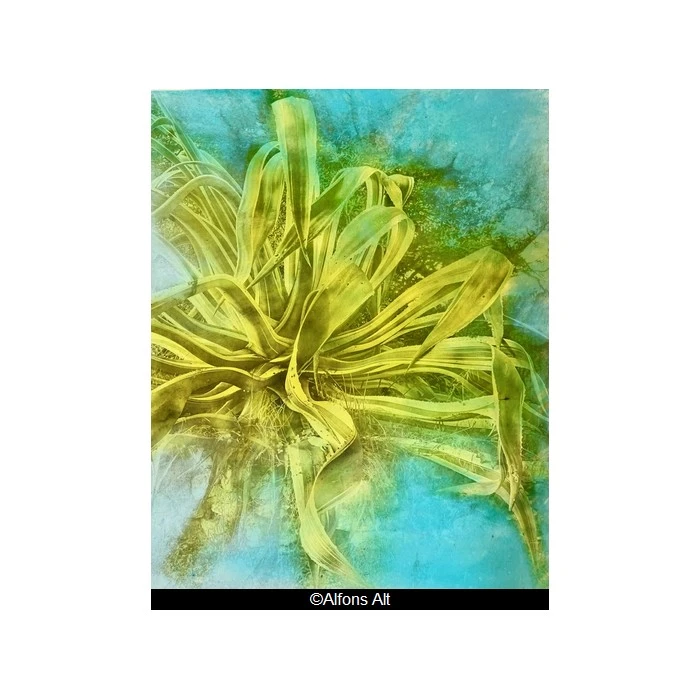
Alfons ALT revisits traditional photographic processes using a technique for creating unique prints that he has named ‘Altotype’. The photographic process is pigment-based rather than silver-based. He selects his subjects through the lens of his camera and then works on his prints as a chemist, engraver or painter, using a wide range of media: canvas, paper, wood, porcelain, glass, copper, zinc…
The photographic work of Alfons ALT uses this ideal process to catch in each work the memory of the subject and the width of time. His work on the animal world has begun with artbooks on Zingaro, showing the force of this so particular relationship between man and horse. He opens now his work to the vegetal world. It is a superb confrontation with the wealth of its structure and the importance of its being.
His works are exhibited in various European galleries, particularly in France and Germany. They have been acquired by numerous public and private collections.

ARTWORKS



EXHIBITIONS & ART FAIRS




BIOGRAPHY
SOLO EXHIBITIONS
Belgium : Bruxelles (Galerie Arthus, Galerie Pierre Le Nain, Galerie Vanhaecke, Galerie Zeuxis Studio)
England : Londres (Galerie Five)
France : Arles (Galerie XIII, Galerie Réattu, Chapelle du Mejan, Editions Acte Sud) ; Aurillac (Musée d’Art et d’Archéologie) ; Aix en Provence (Espace Sextius, Art en Vigne, Pavillon de Vendôme ) ; Bordeaux (Galerie Rouge, Galerie Librairie Mollat) ; Grenoble (Cargo) ; Istres (Théâtre de l’Olivier) ; L’Isle-sur-la-Sorgue (Galeire Le Cinéma) ; Le Puy en Velay (Atelier des Arts) ; Lille (Exposition Zingaro à la FNAC) ; Marseille (L’Entrepôt, la FNAC, La Poissonnerie, Friche de Mai, 3A Architectes Associés, Installation aux Docks, « Les couleurs d’Euro Méditerranée », Galerie Est-Ouest) ; Martigues (Nouveau Théâtre) ; Miramas (Médiathèque) ; Montpellier (Goethe Institut, Villa Olga) ; Nice (Galerie Mons) ; Nîmes ; Paris (Galerie Arcturus, Exposition Zingaro à la FNAC, Galerie Perceval, Agence Verte, Galerie Guigon, Galerie Marie-Laure de l’Ecotais) ; Roquevaire (Galerie Le Cinéma) ; Saint Remy de Provence (Galerie Lezard’ailleurs, Château de Roussan), Vaison la Romaine (La Ferme des Arts) ; Verdun (Œuvre de réconciliation Franco-Allemande au Centre Mondial de la Paix) ; Vimoutiers (Centre d’art Prieuré St Michel)
Germany : Aschaffenburg (Galerie Gerd Lüders) ; Hagen ; Koln (Galerie Burkhard Arnold) Geislingen ; Salzburg (Leica Galerie) ; Stuttgart (Kunstverein Schorndorf) ; Tübingen
GROUP EXHIBITIONS
Belgium : Brussels (Galerie Arthus)
Denmark : Aahrus (Kunstmuseum)
Egypt : Alexandria (Palais de Sidi Gaber)
France : Avignon (Galerie Marina) ; Angoulême (Ecole Supérieure d’Image) ; Arles (Chapelle des Jésuites) ; Aurillac (Foire agricole) ; Fontenoy en Puysaye (Château du Tremblay) ; Lille (Fondation des trois Suisses) ; Marseille (Théâtre de la Minoterie, Galerie Où, Park’art Galerie, Château de Servières, Friche Belle de Mai) ; Marsillagues-Attuech (Fondation CIECLE) ; Rennes (Ecole des Beaux Arts) ; Paris (Galerie Arcturus, Galerie Donguy, Musée Bourdel, Museum National d’Histoire Naturelle, Salon de l’Agriculture, Galerie Guigon, Espace Lhomond) ; Saint Hyppolyte (Galerie du Bout du Monde) ; Versailles (Carré de la Farine)
Germany: Mannheim (Kunstverein Mannheim)
Portugal : Lisbon (Coordoaria Nacional)
Spain : Madrid (Institut Français)
ART FAIRS
Germany : Art Karlsruhe, Rheinstetten
Belgium : Foto Fever, Brussels (Galerie Arcturus)
Egypt : Festival of Alexandria
France : St’Art (Galerie Arcturus) ; Festival de Photographie, Aix-en-Provence ; Festival A-part, St Remy de Provence ; Salon SM’Art, Aix en Provence ;Consul’Art, Marseille ; Rencontres d’Arles ; Alternatif ; Congrès de la Photo Graçay
Portugal : Biennial of young Mediterranean Creators, Lisbon
PUBLIC COLLECTIONS
Belgium : Dexia
Egypt : Library of Alexandria
Germany : Ulm Museum ; Museum of the bee, Illertissen ; Museum of the bee, Neu Ulm
France : Fondation Crédit local de France ; Arthothèque d’Arles ; Arthotèque de Nîmes ; Centre Mondial de la paix à Verdun ; FRAC de Basse Normandie ; Théâtre des Salins à Martigues ; Musée d’Art Contemporain Ziem de Martigues ; Théâtre de l’Olivier à Istres ; E.P.A Euroméditerranée et Fonds Communal d’Art Contemporain à Marseille ; Musée d’Aurillac ; Musée de l’Ecole de vétérinaire de Maisons Alfort ; Gras Savoye ; Ducasse ; Arthotèque de Marseille ; FRAC Basse Normandie ; Arthothèque de Miramas ; Siège social LEICA
Netherlands : Collection Polaroid d’Amsterdam ; FIUWAC Amsterdam
AWARDS AND RESIDENCIES
Winner of the 1% competitions in France and Germany (Théâtre des Salins, Martigues; Land Registry Office, Günzburg, Germany; Caisse des Dépôts et Consignations)
2013: Artist-in-Residence in Hamburg for ‘L’Altonale’ (one-month residency)
2011: Winner of a stay organised by the Institut Français and the Provence-Alpes-Côte d’Azur Region, Mexico
2010: Workshop at the École Nationale Supérieure d’Architecture de Clermont-Ferrand.
2008: Rencontres Internationales d’Arles
2004: Workshop at Villa Arson at the invitation of Laurent Joubert, including a lecture
2000: European Publisher’s Award for photography; Winner of the International Photographic Research Fair, Royan
1999: Founding of FIUWAC in Zeist, NL (a contemporary art collection belonging to all humanity)
1994: Winner of the Young Creators Biennale, Marseille
1991: Photography assignment at the Kunstkamera, St Petersburg, on the Cabinet of Curiosities Collection
BIBLIOGRAPHY
2015 : C. Roy, J. Rothacker, « Alfons Alt, Tentations », Exposition au Pavillon de Vendôme, Aix-en-Provence, Centre franco-allemand de Provence, Aix-en-Provence
2009 : A. Frère, A. Bizalion, « Alfons Alt : Effondrement des Certitudes », Editions Images en manœuvres, Marseille
2008 : A. Alt, S. Nauleau, « La voie de l’Ecuyer : Académie du spectacle équestre de Versailles », Ed Actes Sud, Arles
2007 : A. Alt, E. Loi, « Altitude », Editions Images en manœuvres, Marseille
2001 : F. Gründ, A. Alt, « La ballade de Zingaro », Editions du Chêne, Paris
2000 : A. Alt, « Bestiae », Actes Sud, Arles ; « 5 ou le taureau et les cardinaux : Alfons Alt photographie, Nicko Rubinstein sculpture », Editions Images en manœuvres, Marseille ; A. Alt, « The nauture of the beast », Dewi Lewis edition, Stockport
1999 : A. Alt, « Bestiaire », Editions Acte Sud, Arles
1993 : H. Ratyé-Choremi, A. Alt, E. Marie, « Villages entre Rhône et Durance », Editions Equinoxe, Marguerittes
1990 : A. Alt, O. Kaeppelin, « Zingaro, un théâtre pour des chevaux », Editions First, Paris
1989 : A. Alt, « Zingaro, des chevaux et des hommes », Editions Caracole, Lausanne
1988 : A. Alt, C. Godard, « Zingaro », Editions Favre, Lausanne
TELEVISION
2015: RTS Switzerland (April) “Grand Portrait”
1999: Guest on France 3 Provence’s programme “Le bleu vous va si bien”
1996: Portrait for Martigues Télévision
1994: Portrait for Arte as part of the programme “Bleu Passion” for a Théma evening, directed by J.L. Tacon. Also broadcast on France 3; Portrait for SWF 3, Europa Magazin, directed by Lourdes Picarreta, Baden-Baden. ; Feature for France 3 PACA, Thierry Bezert’s programme. ; Feature for M6 and Marseille Citévision (cable)
1993: France 3. Photographic illustrations for a documentary marking the centenary of “Jean Baillard et les Cahiers du sud”, directed by J.C. Bonfant
PRESS


WRITINGS
RESINO-PIGMENTED PAINT: THE BASIC PRINCIPLE
This pigment-based, non-silver photographic process relies on gelatine’s ability to harden when exposed to sunlight (ultraviolet light). Depending on the duration of exposure, the gelatine hardens to varying degrees on the surface of the print (halftone prints).
When the photograph is rinsed to remove the potassium dichromate (photosensitive agent), which was initially applied to the gelatine and then frozen, pockets of water form in the softest areas.
It is thanks to these pockets of water that pigments can be added to the surface of the print, as the water helps to fix them. The image is then formed as the pigments are applied using a very soft brush. The print is then heated to around 40 °C, making the image permanent.
This process therefore offers great aesthetic possibilities, precisely because of its simplicity: any alteration to the application of the gelatine or to its composition will influence the final appearance of the image. Similarly, the application of pigments involves chemical reactions that set the image in motion and allow for immediate intervention.
The image is in motion and appeals to all the senses. The wealth of detail derived from the photograph, thanks to the meticulously crafted reproduction, gives way to a new “materiality” which, at that decisive moment of pigment application, brings about a kind of revelation.
“A pool of water enriched with manganese red moves towards a streak of malachite green and is violently halted.” To the reality of the photograph is added the divine quality of the painting.
By Alfons ALT, May 2000 (translated from French)
–
ANIMALITY
The question raised here regarding the animal aspect is: what is the animality of what some still call art?
Is there a continuity between the weaver bird, the insect builder, the mole’s tunnel and the artist’s gallery?
Is it the animal nature of people that drives them towards works that are attractive or repulsive, conceived and displayed by artists who ‘expose’ themselves in parades of animal seduction?
Does the artist who defines himself as such lead us through his nature or through his culture, which he often believes he has secreted?
What if the secret lay in the fact that culture itself takes root in the animals that preceded humankind? Does the bird not learn to sing, does it not pass on its song to its young through learning?
So! Where does the animal end, and where does Man begin?
Is this still a valid, a genuine question in the third millennium?
Does the artist have any answers?
Doesn’t he raise even more questions with his answers?
We will answer all that, yes, but man invents, reappropriates and tinkers with our natural heritage through art, science and technology. Are we so sure that animals are not capable of doing the same?
Bedbugs, centipedes and spiders, naturally equipped with functional sexual organs, perpetuate themselves and reproduce without using them, resorting to inventive deviations—which Sade would never have dared to imagine—to enhance the reproductive success of their species. So, where does the animal end and man begin? What if our fantasies, our phantasmagoria, our mythical chimeras projected by artists in their works were rooted in these animalistic archaisms, as certain psychiatrists and psychoanalysts suggest today?
Is the question of animality properly posed? Posed by whom? The artist? The scientist?
Who would dare to ask the reverse question: that of the humanity of the bedbug, the mole or the horse, even if presented in the form of a centaur? Would it make any sense?
Perhaps it is the certainty of the irreversibility of time and the historical momentum of the evolution of animal species that give it meaning!
In ‘The Metamorphosis’, it is Kafka who reverts to a woodlouse in a dazzling artistic vision, whereas it is the woodlouse that moves towards Kafka, but it leaves time behind it—a few billion years. As for the myths of animality, not to say bestiality, they undoubtedly originated with the emergence of the weak and helpless Homo sapiens, who had to surpass the animal in order to survive, feed themselves and defend themselves. Fear of ferocity often overcomes them. Thus the poor Actaeon, setting out to hunt with his dogs, startles the beautiful Artemis, a stern and cruel virgin, whilst she bathes. She splashes him with water and transforms him into a stag. He is then devoured by his dogs. Yet Artemis is the friend of the centaur Chiron, born of the love of Saturn, who, disguised as a horse, seduces the Oceanid nymph Philyre. They often hunt side by side, and Artemis values the Centaur’s knowledge of botany and astronomy. Artemis will come to be known to us as Artemisia, or wormwood, and the Centaur as centaury, or cornflower. Another centaur, Nessus, carries the beautiful Dejanine on his back to help her cross the river Evenus, but Hercules pierces him with an arrow and he dies on the opposite bank, setting Dejanine free as he falls.
In mythology, the animal-human confrontation is often ambiguous. It has been widely depicted in painting and sculpture since ancient times.
Similarly, Pan, half-man, half-goat, leaping out of a bush, sends the world into a ‘panic’. Here we are in the realm of the hybrid, the chimera, the mythical beast, such as Pegasus, the unicorn, the sphinx, the devil, and so on…
This fantastical world, which likely reflects the fears of the earliest Neolithic herders, has been passed down to us by artists.
In the 20th century, the confrontation became more brutal, more direct. This was the case with Joseph Beuys, the German artist who, in an American gallery, had himself locked in for a week with a live coyote, under the title ‘I love America and America loves me’.
It’s hard to take the artistic confrontation between man and animal any further.
It is likely that things will be different in the third millennium with genetically modified organisms. Did we not, with Eduardo Kac, an American artist, witness in 2002 the birth of rabbits that glow green under ultraviolet light, an effect achieved by injecting jellyfish genes encoding a green fluorescent protein used by cephalopods in their courtship displays? Has metamorphosis not been a common practice among visual artists since time immemorial, even if, on each occasion, religion, morality and ethics get involved?
‘GMOs, are you there?’ we ask, blindfolded. They’re already there, on our plates; will they go so far as to enter our galleries and slaughter our sons and our partners? It depends on us, on you, and on art too—insofar as that word has any meaning.
By Claude GUDIN (translated from French)
Claude Gudin has worked as a gardener, an engineer and a doctor of plant biology. His scientific career, dedicated to biotechnology, has taken him from the French National Institute for Agricultural Research to the French Atomic Energy Commission, via British Petroleum. He is the author of numerous scientific articles and patents, several books, and poems and songs for young and old alike.
–
ALFONS ALT – ANIMALITY IN PHOTOGRAPHY
Alfons Alt’s photographic work on animality began with his books on Zingaro. This troupe revolutionised equestrian performance by treating horses as if they were human actors. The notion of “man’s noblest conquest” as applied to the horse is thus profoundly transformed: a new kind of community is established between man and animal. It is perhaps on the premise of the existence of a close relationship with animals that Alfons Alt embarks on a wholly unique artistic journey as an animal artist of the early 21st century. His way of viewing the animal as “an allegory of our virtues and our miseries in a universal language”, whilst reminiscent of a bestiary akin to that of the Middle Ages, nevertheless diverges from it by considering the animal not as a creature akin to the devil but as a form of closeness to humanity. When Alfons Alt says that “man uses the metaphor of the animal to speak of himself without this implying him directly”, we can draw another lesson from this. It is not merely a matter of allegorically rediscovering the animalistic element in man: it is also a question of bringing to light humanity in the form of traces or potentiality within the animal. It would therefore be wrong to view this work as the development of a minor genre within the tradition of the Academy of Painting, which placed the animal genre at the bottom of the hierarchy of genres by linking it to still-life and hunting scenes.
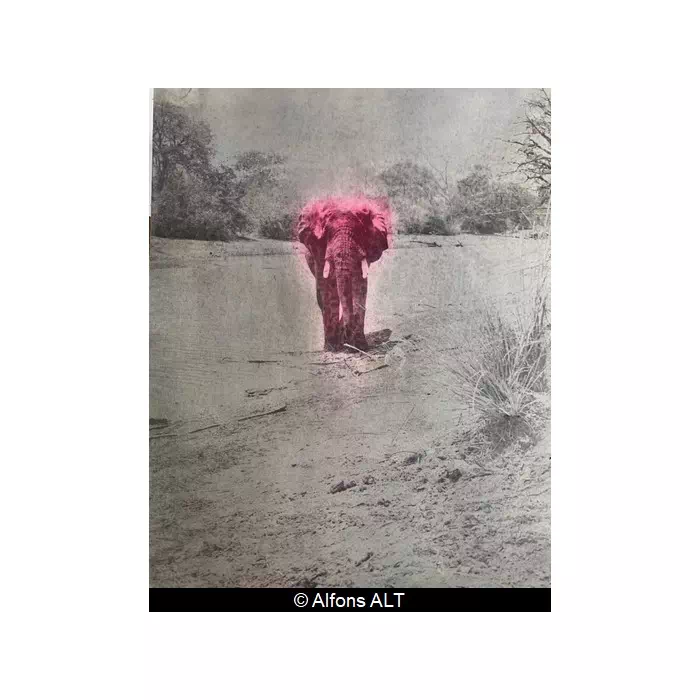
The way in which Alfons Alt wrote the captions for his bestiary perfectly illustrates his photographic approach. The animals are captured in life and, with the exception of the octopus, are depicted in their wild or domestic state. This results in a photographic confrontation that is sometimes difficult to achieve and all the more powerful for being brief (ram, elephant or wolf). The directness thus created (the sudden face-to-face encounter with the animal) can also, paradoxically, be reversed. The dignity that Alfons Alt seeks to restore to the animal can also be seen in the way the animals are depicted in profile; this representation creates a true mental image of the species, as in the case of the oryx, the rhinoceros or the turkey. One of the most original shots reverses the frontal perspective by presenting the spectacular rear end of a horse (jazz).
However, whilst each animal is meant to evoke familiar, conventional imagery, the aim is not to document a species. Each animal has a name (Raspoutine the Percheron, Jimmy the macaque, Inédit the bull, Klaxon the swan, or at the very least Madame the frog…) and the image becomes a portrait. Both the ram and the bull thus look directly at the camera. The framing also links the work to the practice of portraiture.
Speaking of the octopus, Alfons Alt admits that he sought “a pose that best evokes a fictional character”. Most of the time, the animal is alone, isolated. The (dominant) colour scheme chosen tends to highlight its physical form, maintaining only a symbolic link to reality. This is a far cry from photographic work intended to document reality.
In a sense, Alfons Alt retains only the centre of the image: the edges, from which a few plant details emerge, serve to create an overall texture. The use of an ochre-coloured background evokes the techniques of 18th-century portraitists in its shimmering rendering. The photographer’s masterstroke lies in unifying the figure and the background within a single colour palette.
The technical process, however, is indeed that of photography par excellence, as the artist likes to point out. The use of a large-format camera is significant. The pigment print is one of the oldest photographic techniques, capturing everything—including any imperfections. It is indicative of Alfons Alt’s interest in the first twenty years of photography. The artist’s aim is always to move towards the painting and to resist the industrialisation of photography. All the work is done by hand; he seeks to rise above the ‘crude and vulgar’ nature of photographic technique, as if this were now an act of transgression. In the way Alfons Alt uses this old photographic technique – to produce images whose modernity cannot be denied nor confused with old photographs – he chooses to preserve or obliterate incidental details. The image is composed of some photographic elements and some elements resulting from a destructive gesture: paradoxically, it is through destruction that the animal portrait becomes a painting and a unique work, as the destruction is never identical. The colouring with pigments, with highlights sometimes applied to certain paintings such as the red head of the turkey, also resembles a brushstroke.
The symbolic reference to the bestiary is complemented by a wide range of references to art history. Dürer for the hare or the rhinoceros, or Beuys for the wolf/coyote. Géricault’s work on the equine breed is also essential and forms the basis of the artist’s work. The symbolism is enriched by more surprising references, such as Batman for the bat. The photograph of the snake seems to open up a new path. The different framing is arranged in the shape of a cross. The image of the animal appears five times, and this repetition recalls the spatial organisation of icons depicting the lives of the saints. The symbolic meaning is thereby reinforced and introduces a new perspective into Alfons Alt’s work.
By Sophie BIASS-FABIANI (translated from French)